
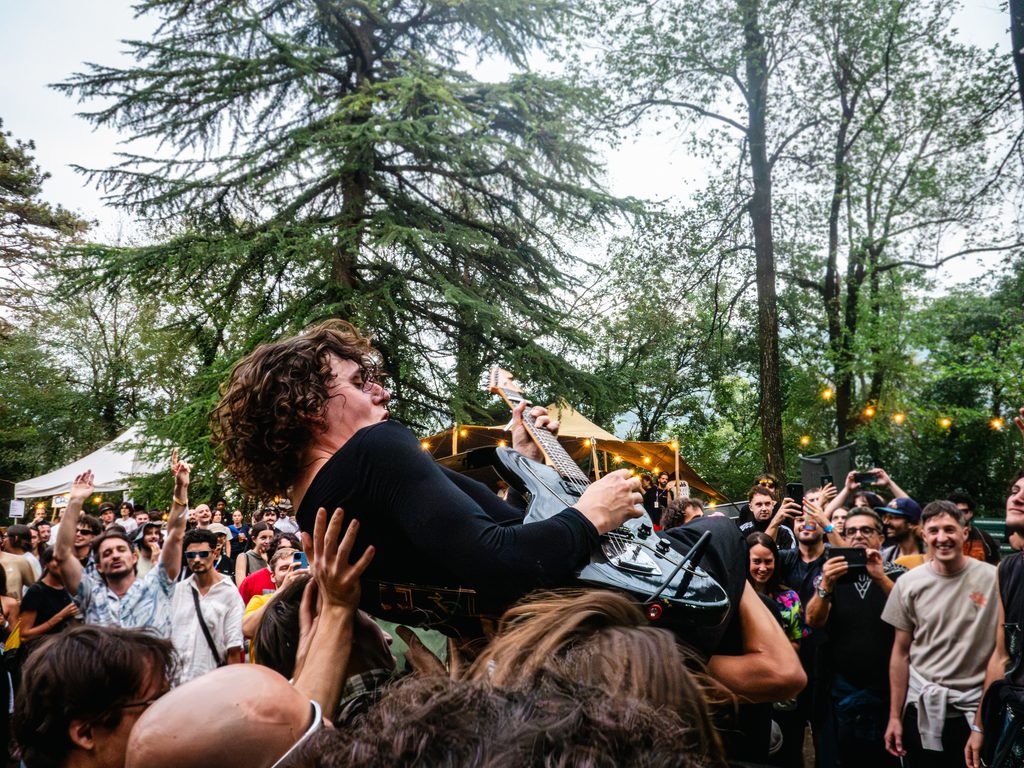
Van kleine podia naar festivals en eindeloos veel kilometers op de weg: voor een band is het live spelen minstens zo bepalend als de muziek zelf. ELLiS·D weet daar inmiddels alles van. Met hun energieke liveshows en een sound die zich niet gemakkelijk in één hokje laat stoppen, blijft de band nieuwe zalen en festivals aandoen.
Tijdens Poplar Festival spraken we met frontman Ellis Dickson en bassiste Sammy Jones. Tussen de voorbereidingen voor hun show door hadden we het over de dynamiek van optreden, het leven onderweg, en het opnemen van nieuwe nummers. Ook spraken we uitgebreid over de onlangs uitgebrachte Spill Live EP, waarop de live-energie van ELLiS·D rechtstreeks is vastgelegd. Hoe is het om die nummers iedere avond opnieuw tot leven te brengen, en wat verandert er wanneer de versterkers aangaan en het publiek voor je staat?
When did you first start playing music?
Ellis: I was really young. I probably started making music when I was around eleven or twelve. I played in all sorts of different bands at school, and it just carried on from there. When I was in my early twenties, I played in probably a hundred different bands around Brighton. I was always involved in music and mainly played drums. At some point, I thought it would be fun to start a solo project and see what happened. Just to have some fun with it. That project kept growing and growing.
Sammy: I didn’t play bass before. During lockdown, I basically begged Ellis to let me join the band. I said, ‘If I can learn to play bass by the end of lockdown, can I be in the band?’ He said yes, so I used that time at home to learn how to play. And now, here we are six years later.
What role did music play in your home when you were growing up?
Ellis: There was definitely a lot of music in the house when I was growing up. Both my parents had really great and really diverse taste in music. I remember listening to a lot of The Smiths when I was young, while my mum is a huge disco fan. So there was a really wide variety of music playing at home. It wasn’t really until I started secondary school that I began playing an instrument myself, and I just fell in love with it straight away.
Ellis, when recording songs in the studio, you play every instrument yourself. What does that process look like?
Ellis: Because I started out as a drummer, I often start songs from the drums. I’ll try to find a beat or a rhythm first and then add guitars, keys or other things later. Sometimes it happens the other way around. But in the studio, I really like being able to jump between different instruments. It helps with the writing process.
Once a song has been recorded, does it change when you start playing it live with the rest of the band?
Ellis: Definitely. Whenever you bring a new song to the band and play it live for the first time, it’s always a little bit nerve-wracking. You don’t really know how it’s going to turn out. We’re generally quite good at making the songs sound like the record live, but with a little bit of extra punch. We also play with different musicians depending on who’s available. Everyone brings something slightly different to the sound. I actually think it’s quite exciting for every show to be a little different. It keeps you on your toes.
Sammy: We always play a song live after it’s already been recorded. That means we know how the song is supposed to sound before we take it on stage.
Ellis: The basic structure is pretty set, but there are certain parts where we leave room for interpretation. Sometimes there’s space for a jam or someone can approach a section differently. Other parts are more like: this is how the song goes.
How much freedom do you and the other bandmembers have on stage?
Ellis: Quite a lot, especially with the smaller details. Some of the drum fills on the record were improvised in the studio, for example. If you try to recreate those exactly every night, it can actually sound unnatural. Sometimes that loose, slightly imperfect feel is what makes them work. It’s about finding the balance between: this is the song, but within that song there’s room for little things to change every night.
Sammy: I generally stick to the bass parts as they are, but I also react to what the other musicians are doing. If a drummer plays a particular fill a few times over several shows, you start to recognise it. Eventually, you can almost predict what they’re going to do. That just comes from playing together for a long time. You become more and more in sync with each other.
You recently released the Spill Live EP, recorded in V11 Rotterdam. Where did the idea to record a live EP come from?
Ellis: It was an idea I had for a long time actually. I spoke to someone at our merch table at a festival last year. He’d bought the Spill studio record and said to me, “You guys really need to do a live version of this.” He was pretty drunk, but I immediately thought: that’s actually a really good idea. Ever since that conversation I had the idea in my head. We’d originally only released the Spill EP in a limited run. Once it sold out, we had to think about what to do next. We could have repressed the record, but I thought this might be the perfect opportunity to make a live version instead. People could hear the same songs again, but from a completely different perspective. The fact that we could record it at our first sold-out headline show outside the UK, in Rotterdam, made it even more special. We worked with the Left of the Dial team who were amazing and being able to record the show on a boat. Everything just came together perfectly.
Was it nerve-wracking knowing that the show was being recorded?
Sammy: Yeah. Normally, you play a show and then it’s over. This time, we knew that the show was going to be on a record and would exist forever. That definitely adds a bit of anxiety.
Ellis: You try to forget about it while you’re on stage, but you can’t completely. You’re still thinking: okay, this is being recorded.
Sammy: I didn’t really think about it that much during the show.
Ellis: I had one moment where I thought: oh no. I hadn’t put my capo on properly and it killed one of the strings. I’m glad nobody has brought it up so far.
What does a live recording capture that a studio recording doesn’t?
Sammy: Energy.
Ellis: Absolutely. I think it’s a really nice snapshot of where you are as a band at a particular point in time. In the studio, you can keep going back and re-recording things and making changes. With a live EP, it is what it is. That recording will probably never sound exactly like that again. Bands change live, play different sets, and you keep growing as musicians. So I think it’s really interesting to capture a kind of portrait of a particular moment in time. Especially for us, because we’re still relatively early in our career. I’ve always found it fascinating to listen back to old live albums from bands, especially from early in their careers. You can literally hear what they sounded like at that point in time. It’s nice to think that maybe someone will listen to this recording thirty years from now and hear what we sounded like when we were young and fresh compared to when we’re haggard and tired.
You spend a lot of time on the road. From the outside it all looks great, but it must be exhausting at times. How do you deal with that?
Sammy: It’s fine now, because we’re at a point where now, when we play shows, we get hotels or we can afford to stay at a hostel. When we were younger and touring, we’d sometimes sleep on people’s floors for two weeks. Now I’m living a dream, it’s just more comfortable.
Ellis: When you’re 21, it’s great to sleep on people’s floors. You’re on the road, you’re drinking, you’re having fun. But there’s only so long you can keep doing that. If you’re constantly on the road, at some point you have to start looking after yourself.
Is there more awareness nowadays around musicians’ wellbeing while touring?
Ellis: I think so. There’s more understanding of how demanding a touring schedule can be and how important it is to look after yourself. People have sort of seen through the whole classic ‘sex, drugs and rock ’n’ roll’ lifestyle. Ultimately, it’s more important to look after yourself so you can play better and have a longer career and write better music.
Sammy: We’re just more responsible now.
Ellis: Exactly. Sometimes that just means going to bed at 9:30PM. When you’re somewhere beautiful like this, in the mountains in Italy, you definitely want to have a few drinks after the show and relax. It’s about picking the right moment. You can’t do that after every show, but you can still have fun.
Finally, do you have any advice for bands who are just starting out?
Ellis: Definitely never lose hope. I think there’s something hidden behind the success of a lot of bands: almost every band has been grafting for years before they get anywhere. Nowadays, it’s easy to discover a band through social media. You might see five posts and think they’ve only had three rehearsals and suddenly they’re everywhere. In reality, a lot of those bands have already been going for five years or more. They’ve put in all those hours in the studio and rehearsal room. But the most important thing is to make sure you’re having fun. Keep making music because you enjoy it, regardless of where you’re playing or how many people are watching. If you’re having fun doing it, you’ll look back later and think: I had a great time. That’s what really matters.
Geef een reactie